Research & Projects
I’m interested in using deep generative models to extract information from galaxy survey data.
SBI and the Dodelson-Schneider effect
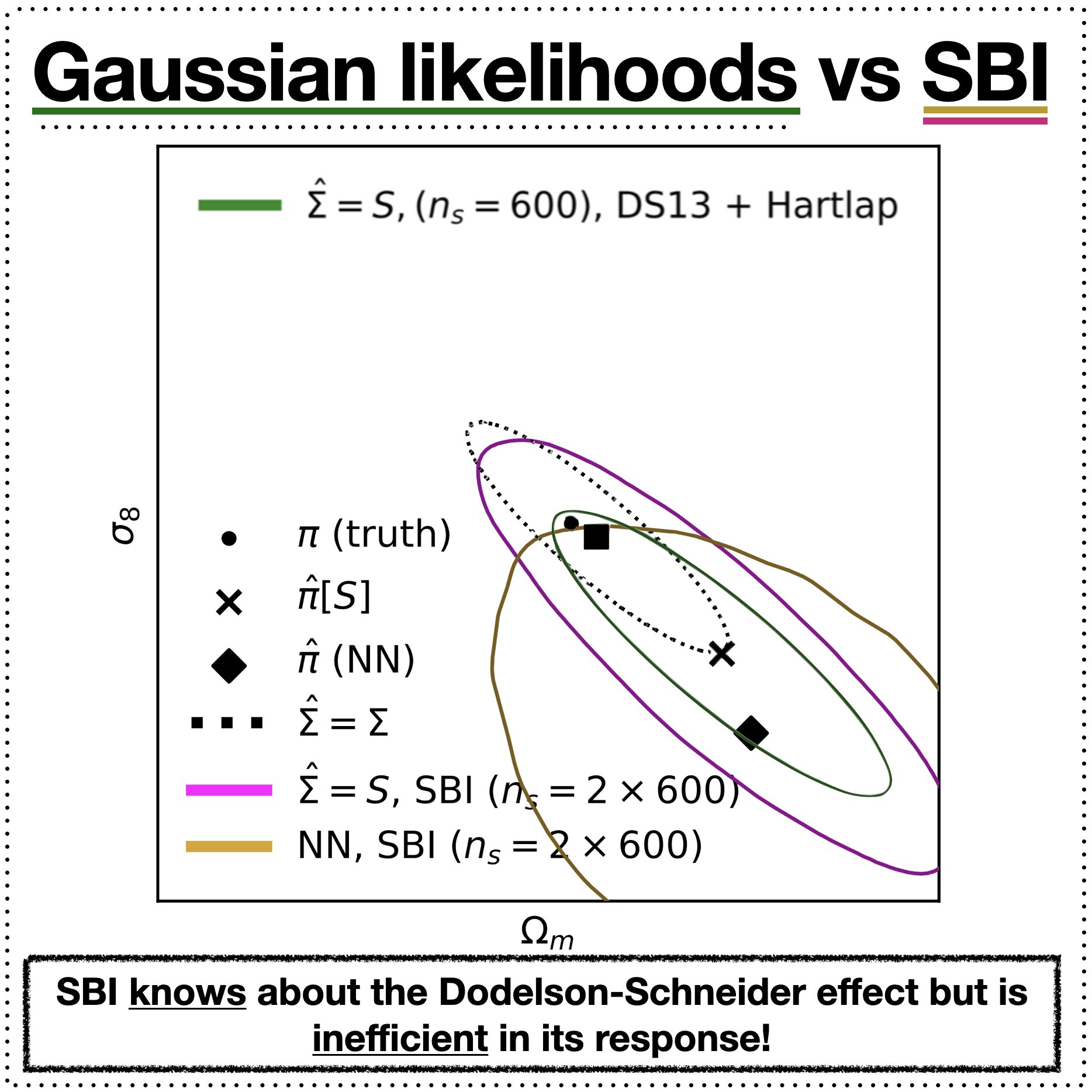
SBI has it’s own Dodelson-Schneider effect (but it knows that it does)
Jed Homer, Oliver Friedrich & Daniel Gruen [2412.02311]

Can generative models really be used for inference? What are they really doing?
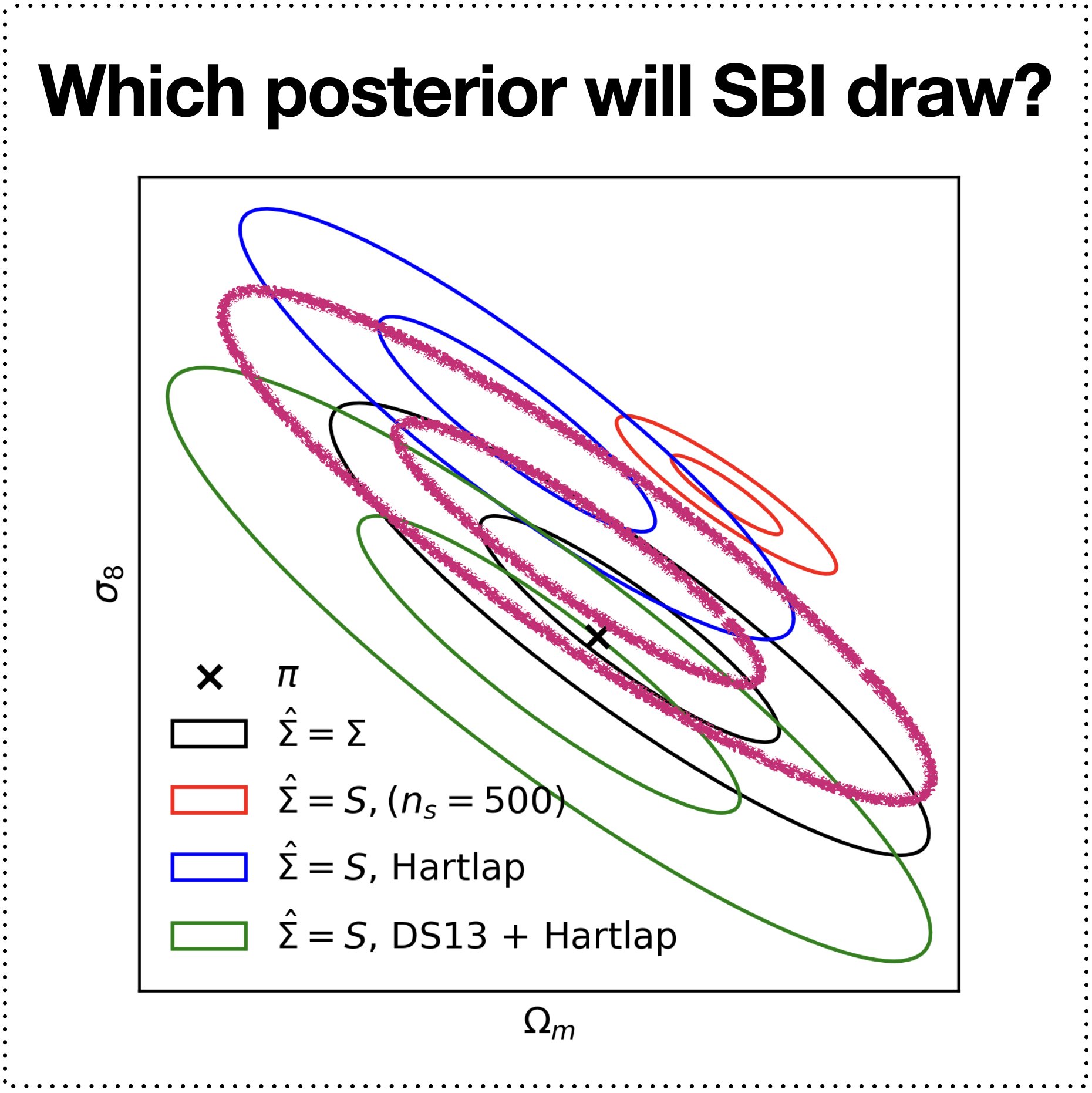
The bad news is that, contrary to commonly held beliefs, SBI methods cannot escape (nor should they!) the effects of covariance estimation - the models cannot invent information upon the likelihood from simulations.
The good news is that generative models, when used for simulation-based inference (SBI; as a density estimator for either the likelihood or the posterior), can reliably fit the target distribution and be used in Bayesian inference problems.
Work done with Oliver Friedrich (USM/LMU) and Daniel Gruen (USM/LMU).
SBI and the one-point matter PDF
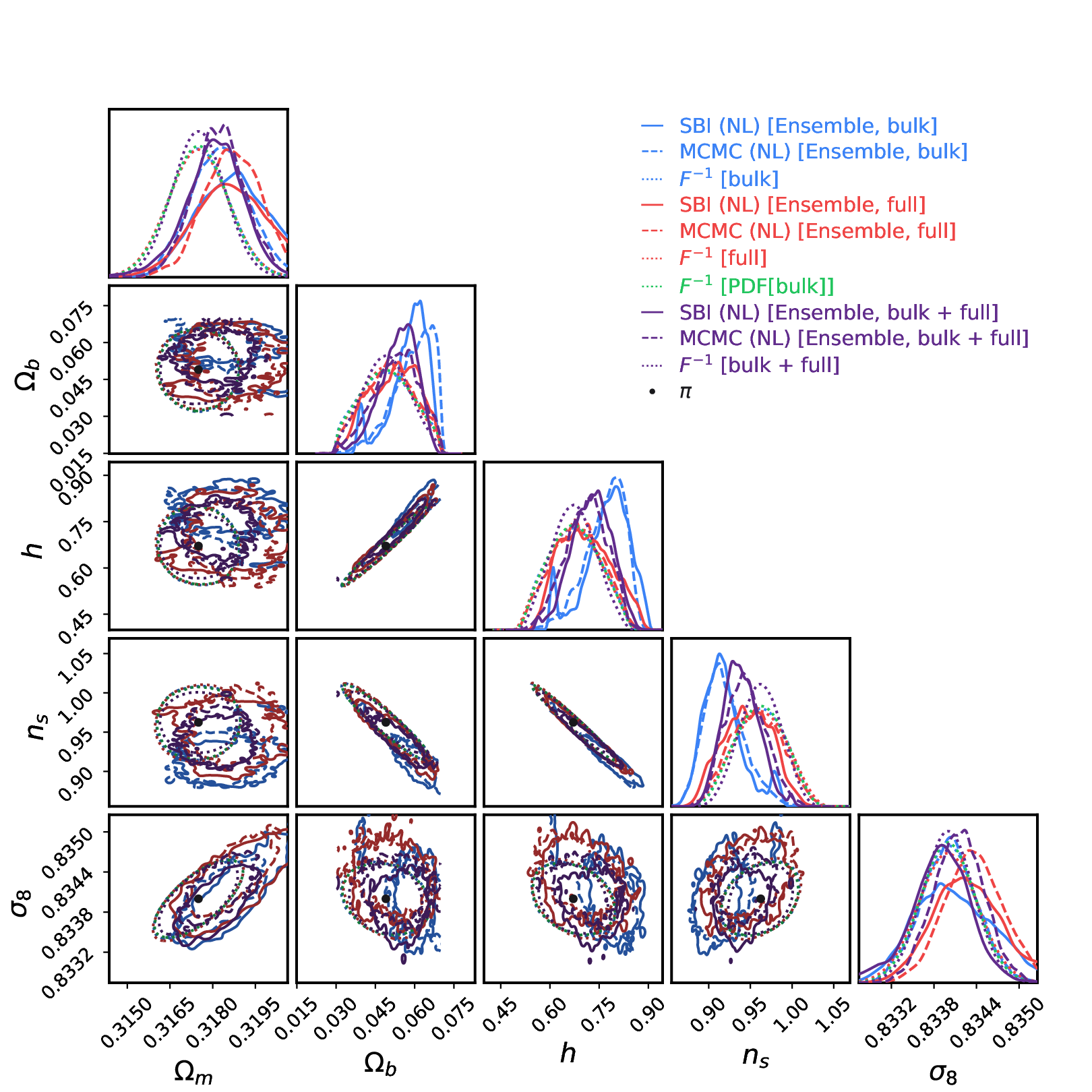
Quantifying the information content of the one-point matter PDF with SBI.
Jed Homer, Oliver Friedrich Cora Uhlemann & Daniel Gruen [in prep.]
SBI is necessary for when we do not know the likelihood function; the function that tells us the probability of our data given a parameterisation of our model. When the form is non-Gaussian, it is difficult to model analytically and verify in an analysis.
The question is, can SBI methods reliably extract more information when we know they should?
The one-point matter PDF is a counts-in-cells statistic that is sensitive to the higher-order moments of the density field - it can extract information beyond the 2pt function for non-Gaussian fields. However, as alluded to on this page, this information is shrouded in our uncertainty upon the form of the likelihood function!
Here I’m showing a plot of a posteriors from independent SBI analyses that combine likelihood models at redshift for the cumulants of the matter PDF measured at multiple physical scales. The corresponding Fisher forecasts are also plotted for comparison.
Baryonification with multi-modal deep generative models
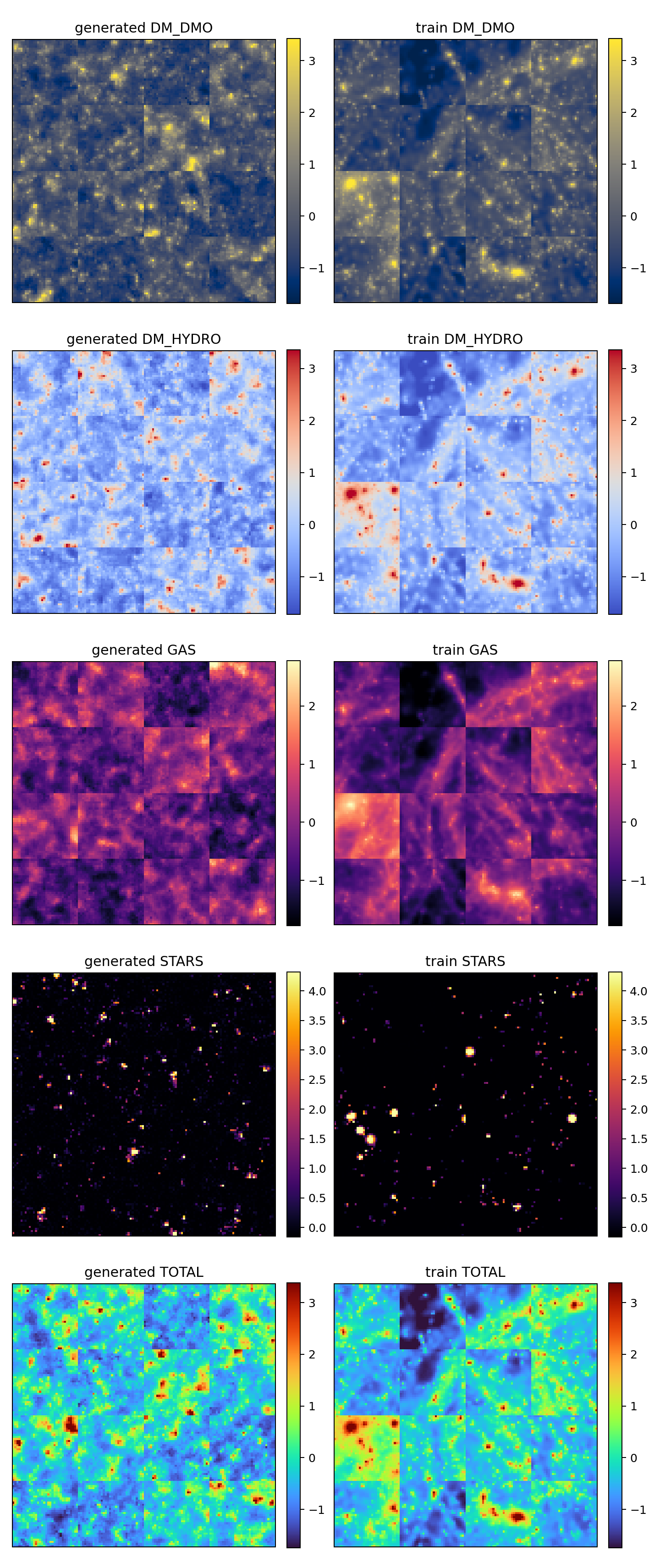
Small-scale astrophysical processes redistribute matter and alter cosmological observables, particularly weak gravitational lensing. Modelling them accurately helps avoid biased cosmological parameter estimates and recover information from smaller scales that would otherwise need to be excluded.
Deep generative models offer a way to learn these effects from expensive hydrodynamical simulations and apply them to cheaper simulations. Once trained and validated, they can rapidly generate realistic baryonic fields without evolving the full gas physics for every realisation. This makes large collections of mock observations more affordable, supporting uncertainty estimation and repeated comparisons between models and data in cosmological analyses.
In this work we employ a multi-modal flow matching model to extract baryonic physics from multiple outputs (“modalities”) of the Flamingo simulations. We seek a low-dimensional latent space for interpolating across different baryonic prescriptions in a downstream cosmological analysis.
Work in progress with Dr. Jozef Bucko and Dr. Tomacz Kacprzak at ETH Zürich.
Generative models
Generally speaking, the likelihood is not known in an inference problem. Speaking more generally still, this limits the amount of information we can extract from our data upon fundamental physical parameters.
Generative models posit (very tenuously!) an interesting solution to this problem by parameterising the likelihood with a set of parameters (usually of order millions to billions of them) and an architecture - all fit by maximum likelihood (or score-matching etc.).
I’m interested in the limitations of this paradigm (e.g. simulation-based inference, density deconvolution).
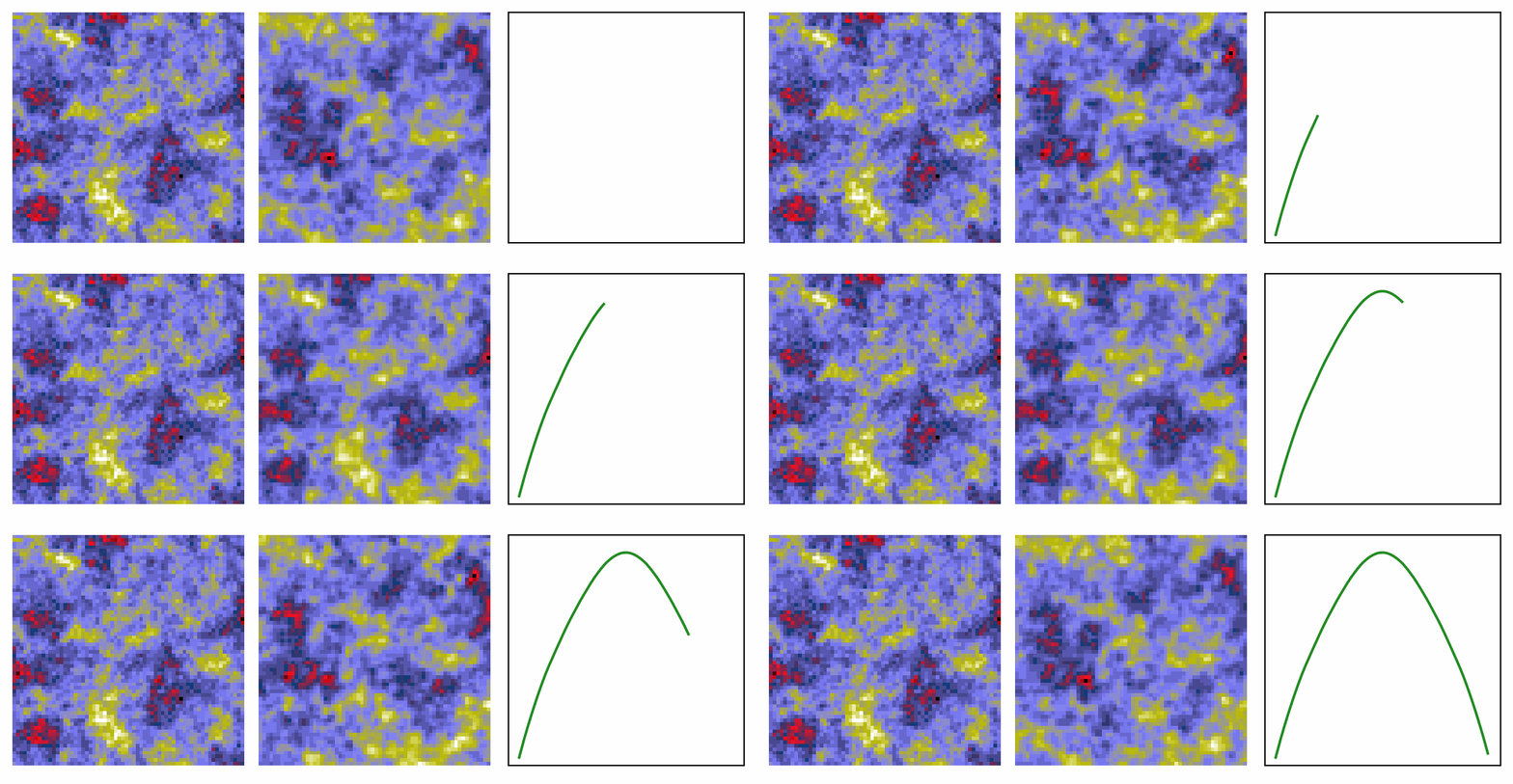
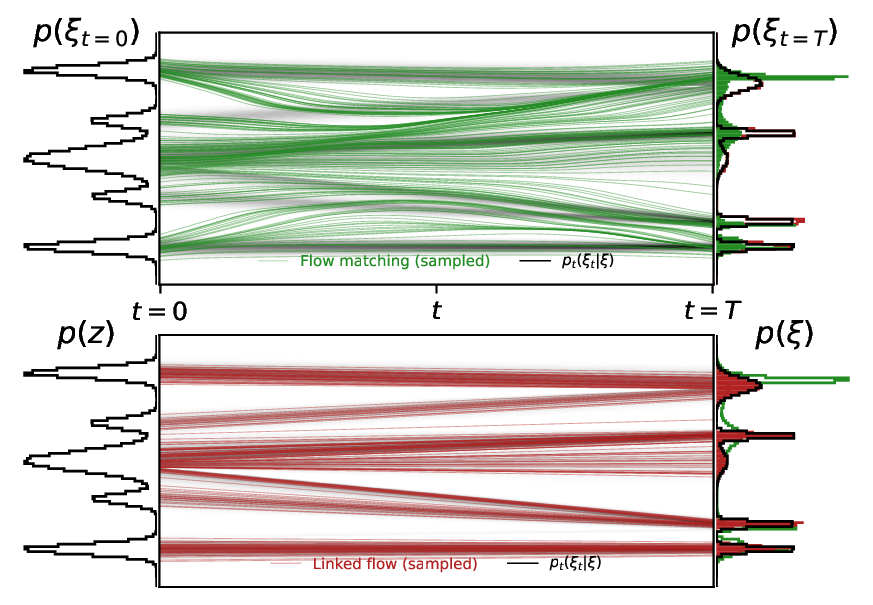
Here are some figures from a paper I’m writing with Nils Schöneberg (LMU/USM) where we attempt to create a one-step generative model.
Neural networks and covariance estimation
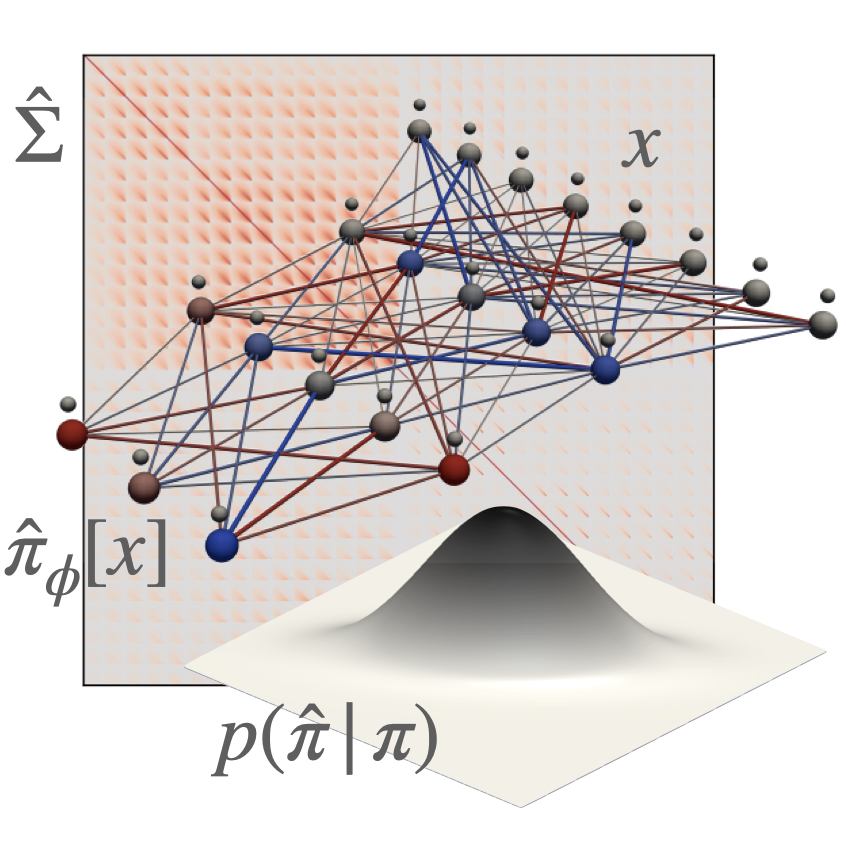
Estimating a covariance matrix from a grid of accurate numerical simulations is ubiquitous in cosmology. It is well known that the noise in such an estimate propagates additional noise into the location and width of the derived posterior contour. This effect - known as the Dodelson-Schneider effect - can be catastrophic for high-dimensional datasets that are typical in cosmological surveys. This effect is important for simulation-based inference analyses also, where compression is necessary to fit the potentially non-Gaussian likelihood from a grid of simulations.
The question is, does there exist an estimator which allows us to extract more information than a linear compression using a noisy covariance matrix? How does this compare to a deep neural network with its various sources of regularisation?
In this project (with Max Pellner (USM) and Oliver Friedrich (USM)) we seek to ask how an estimator - derived using a neural network - behaves as a function of the number of simulations (generated across the physical parameter space). This can be seen as an extension of the Dodelson-Schneider effect to non-linear estimators.
Interpretable solutions to inverse problems
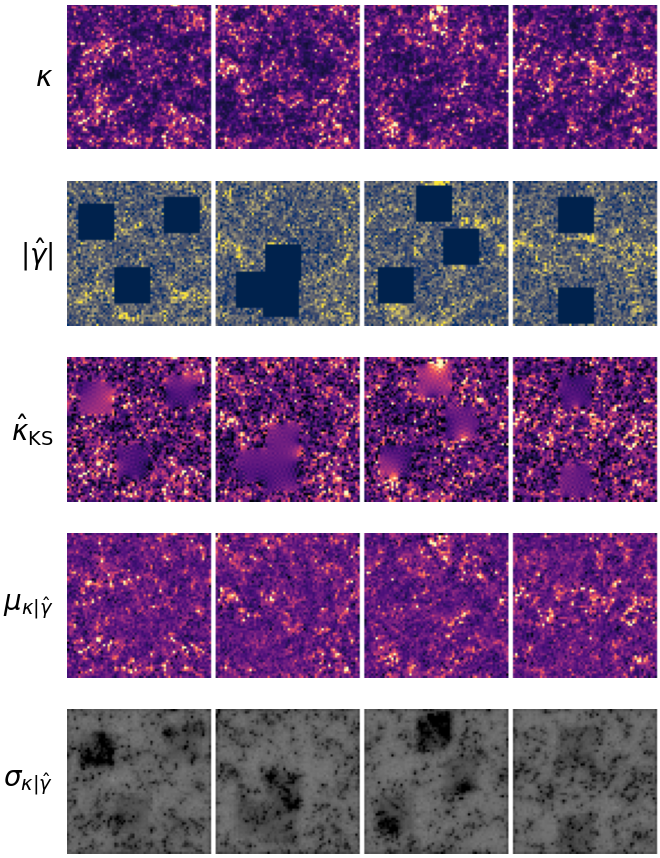
In this project, I aim to test if a generative model can be used as a posterior model in an inverse problem when it is only fit with noisy corrupted observations, instead of clean noiseless simulations. I calibrate the uncertainty in the posterior model when conditioned on noisy observations, comparing the estimator to an analytic solution for the posterior.
I compare the model trained only on noisy observations to a ideal supervised generative model - with access to clean simulations - as well as the classical Kaiser-Squires and Wiener filter reconstructions (the test case concerns extracting convergence from shear in a corruption via additive Gaussian noise and masking).
This tests how well the generative model can do physically - against the analytic solution for the problem - as well as how it fares in comparison to a supervised machine learning solution (which has access to noiseless simulations).
High-dimensional SBI with Metric Gaussian VI and flow maps
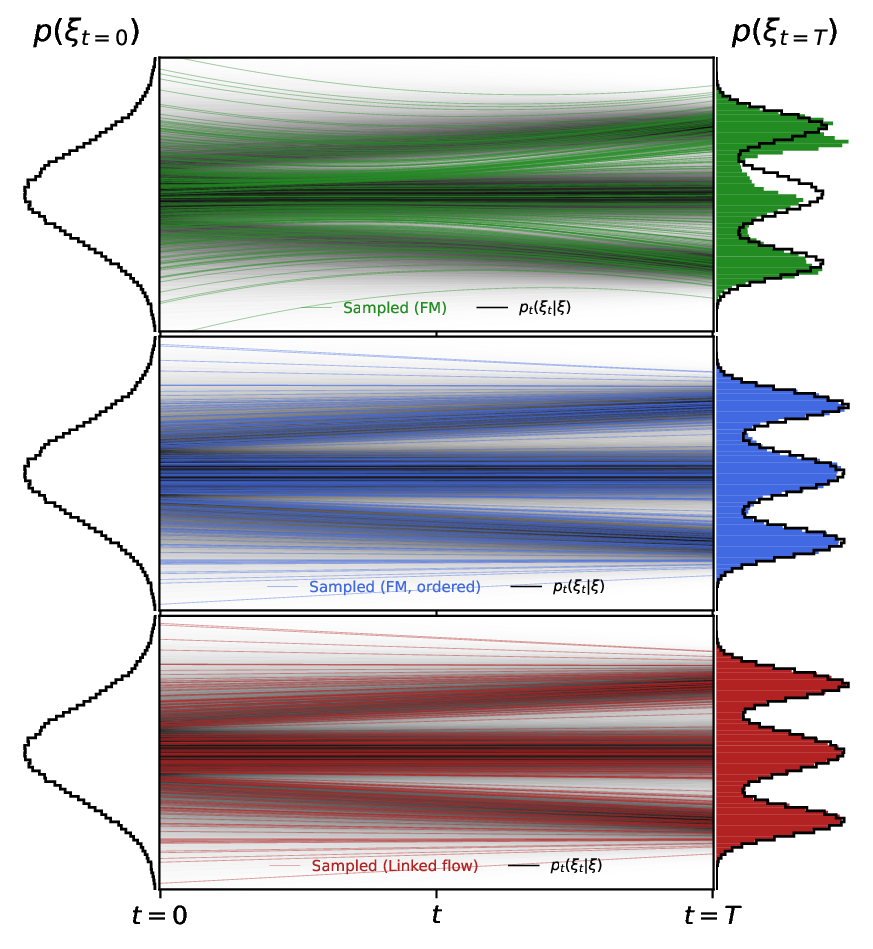
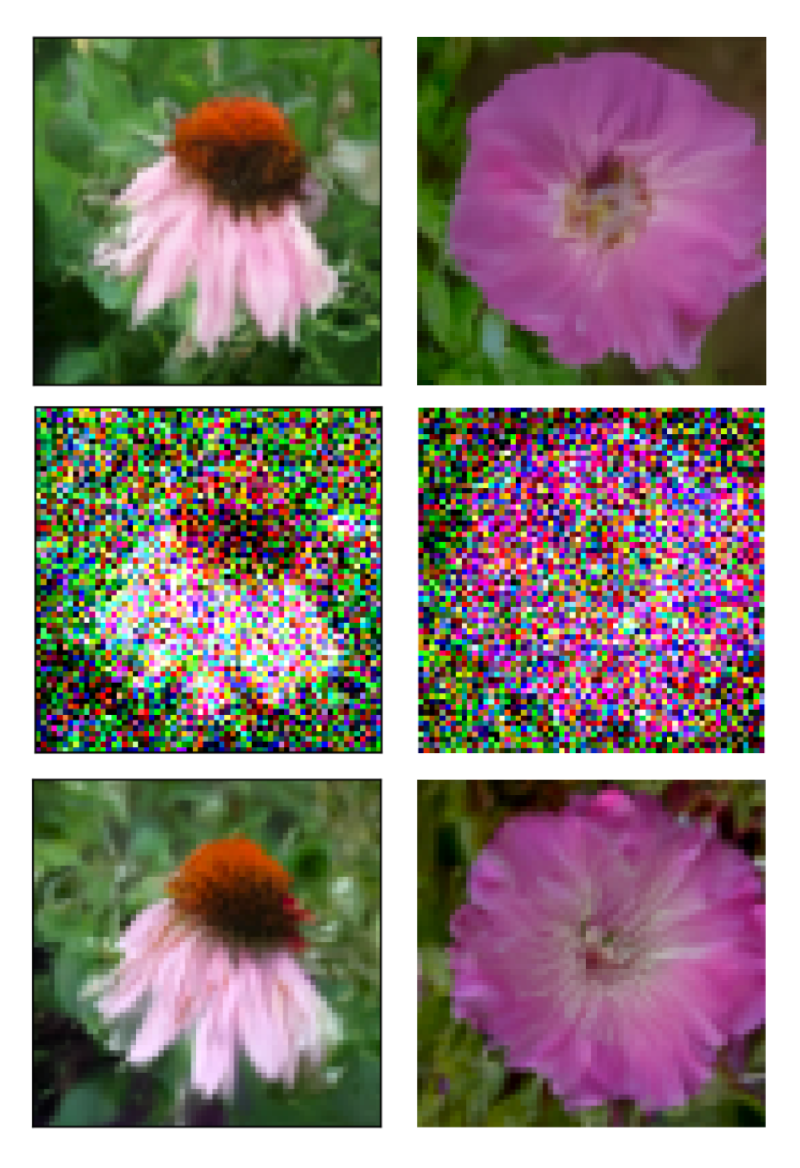
This plot shows signal reconstructions (middle row) from noisy data (top row) using a diffusion model prior.
The posterior samples (bottom row) are drawn using Metric Gaussian Variational Inference from Knollmüller and Enßlin (2019).
MGVI is implemented in the NIFTY probablistic programming package, it is built from jax.
This is fitting a many million dimensional posterior to the latent variables of the generative model.
It works quite nicely (these samples are from the first iteration only!), I plan to extend this to parameter inference problems.
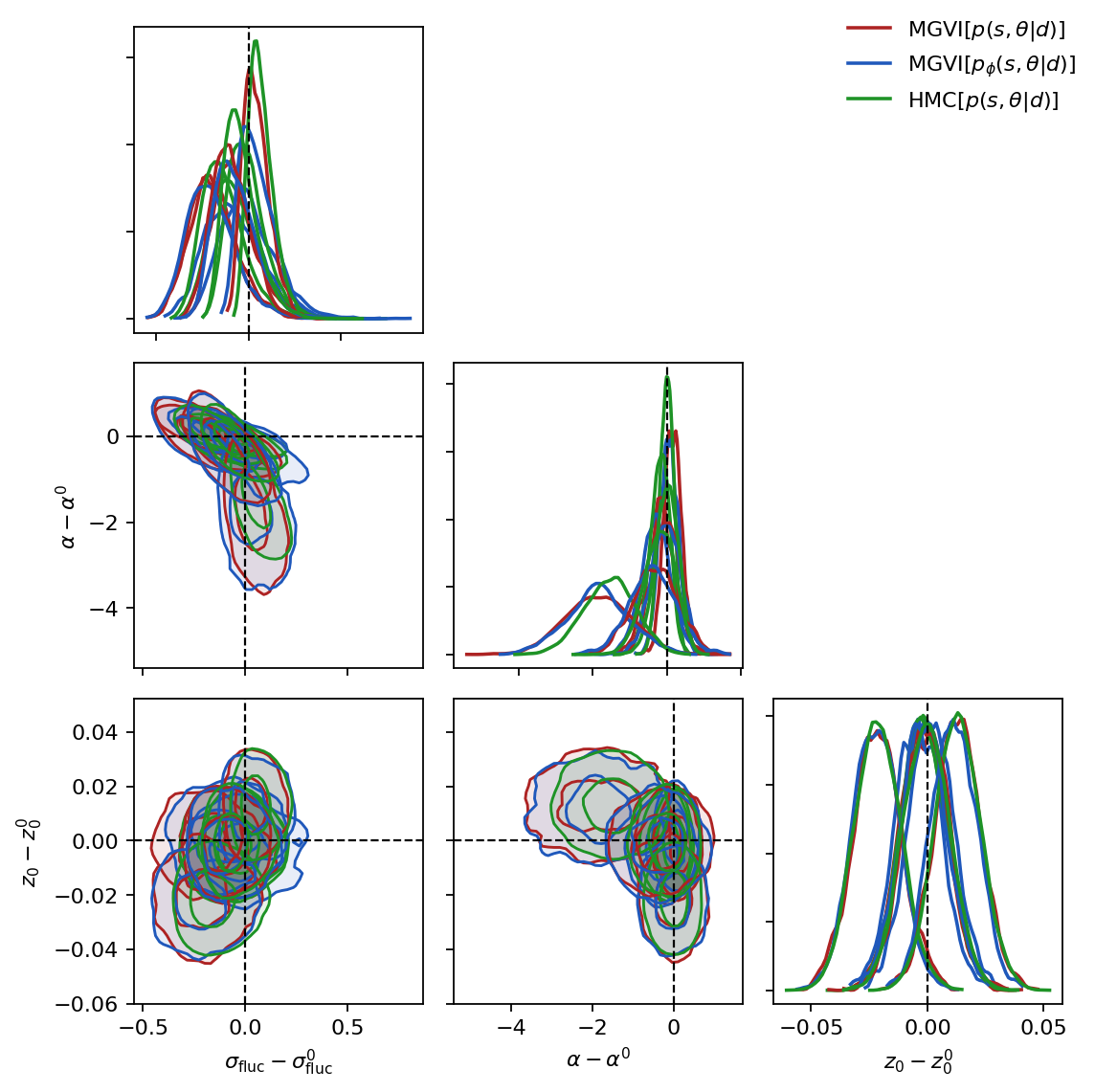
I also applied this framework to a controlled inference problem where we compare an “exact” long-run posterior sampling with HMC to MGVI on the exact posterior model and that same model parameterised instead by a generative model. See here for results from identical experiments.